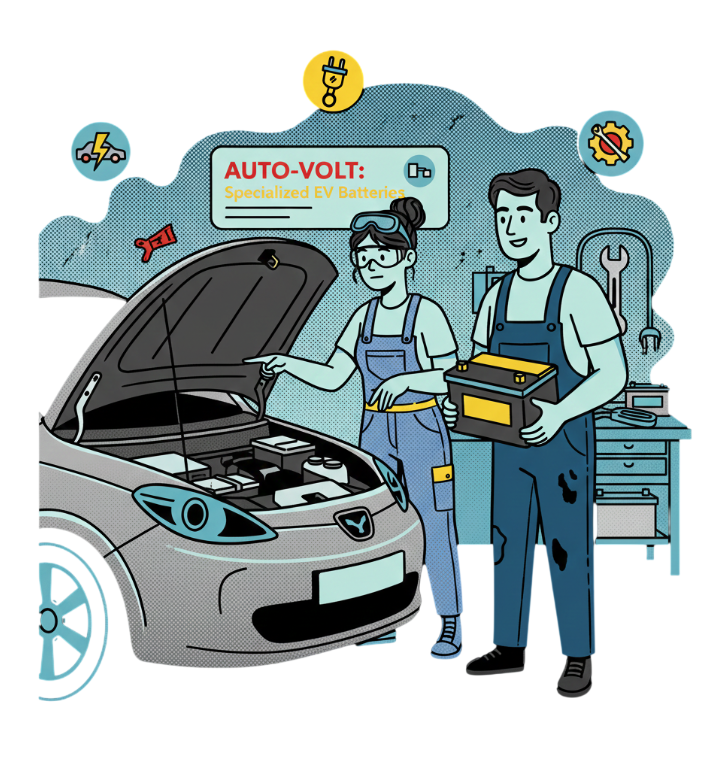
Closing the gap between technical expertise and customer confidence.
Automotive Service Centers
Customer Experience
Market Research
Service Development
Behavioral Insights
To identify and understand current and potential audiences In a highly competitive automotive market, a leading battery brand began to sense a growing gap between brand strength and customer experience.
While its product leadership was unquestioned, the way people experienced the brand told a more complex story, one that would shape the next phase of its evolution.
CONTEXT.
The client is the market leader in automotive batteries in Mexico, with a long-standing reputation built on reliability, technical expertise, and nationwide availability. A core advantage of the brand is its extensive network of Service & Sales Centers, physical spaces where customers diagnose, purchase, replace, and maintain their batteries.
However, the market around the brand was changing. New retail formats, self-service channels, and digital expectations were reshaping how people approached even the most functional automotive decisions. At the same time, Gen Z and Millennials were becoming a meaningful share of buyers, bringing different expectations around clarity, trust, and experience.
The brand was still trusted. But trust alone was no longer enough.
CHALLENGE .
The challenge was not awareness or product quality. It was relevance.
Despite strong brand equity, the Service & Sales Centers were increasingly perceived as technical, intimidating, or “not for everyone.” Younger consumers, especially women, often approached the category with uncertainty and anxiety, seeing the battery as an unavoidable expense rather than a confident decision.
The brand needed to understand:
Why some customers felt comfortable and others hesitant in the same space
Where the experience was creating confidence, and where it was creating friction
How to evolve without losing the expertise that made the brand strong in the first place
The objective was clear: uncover what was really happening inside the experience, and redefine it to work for more people, not just the most knowledgeable ones.
APPROACH
Instead of starting with assumptions about age or gender, we focused on behavior and emotional context.
We observed how people behaved inside Service Centers, how they asked questions, where they hesitated, and what moments triggered trust or doubt. We listened to personal stories around car ownership, breakdowns, and decision-making; mapping not just actions, but emotions.
The most important shift came from a simple question:
How do different people relate to their battery, not who they are demographically?
This led to the identification of distinct customer archetypes, ranging from highly confident, technical buyers to hesitant customers seeking reassurance, clarity, and inclusion.
The critical insight was clear: The experience had been designed almost entirely for one type of customer. Everyone else was expected to adapt.
KEY FINDINGS .
What looked like a generational problem was, in reality, an experience design problem.
The Service & Sales Centers worked extremely well for expert customers, those who spoke the language, understood the product, and valued technical depth. But for others, the same elements created friction:
Technical language increased anxiety rather than trust
Pricing moments felt opaque rather than transparent
The environment signaled “specialist space,” not “welcoming service”
At the same time, the brand’s strongest assets: expertise, reliability, guarantees, were exactly what hesitant customers were looking for. They simply weren’t being delivered in a way that felt accessible.
OUTCOMES .
The project reframed how the brand understood its role, not just as a battery manufacturer, but as a service experience that supports people in moments of uncertainty.
A Clearer Value Proposition
The brand aligned around a renewed promise focused on continuity, safety, and simplicity, without losing its technical authority.
Experience Redefined Around People, Not Profiles
Rather than designing for “young customers” or “new generations,” the brand could now design experiences that respond to different emotional relationships with the product, expert, practical, preventive, or hesitant.
From Insight to Action
The work enabled concrete decisions across:
Communication tone and messaging
Service flow transparency
Physical space and informational design
A clear roadmap to evolve Service Centers without rebuilding them from scratch
The Core Learning
The brand didn’t need to become something new. It needed to become accessible to more ways of being a customer.
By shifting from demographics to behavior, the brand found a path to grow relevance, strengthen trust, and future‑proof one of its most valuable assets.
RECOMMENDED READING CASES .
Behavioral Insights, Customer Understanding, Human Resources, Internal Team Data, Social Affairs