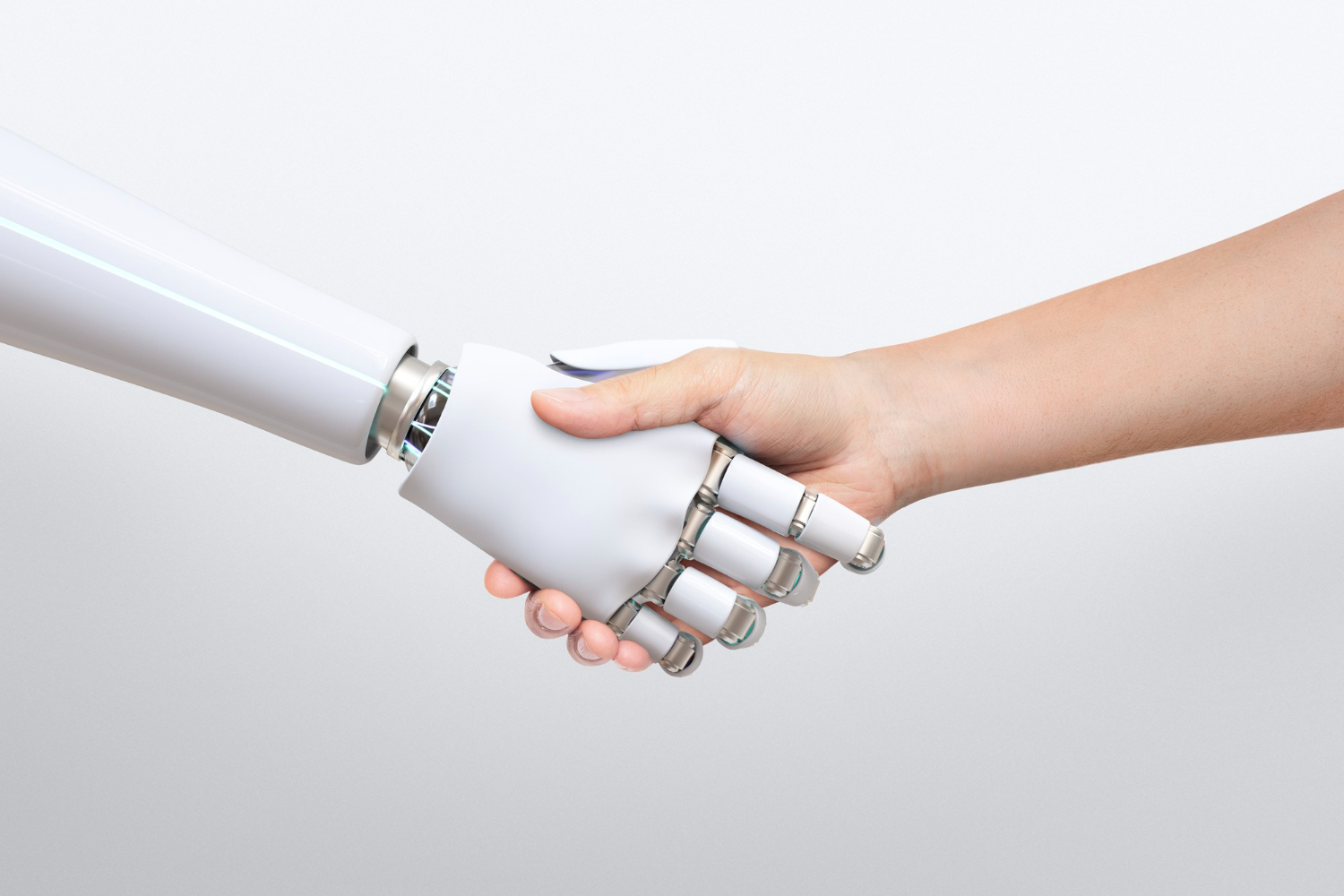
A human-centered look at how AI is changing the way we work, think, and create.
Artificial Intelligence
Behavioral Science
Society
It started in quiet, everyday things...
Long before headlines shouted about generative models and synthetic content, AI was already quietly living in our pockets and routines.
Siri could schedule a meeting. Google Maps could guess where you were going. Spotify knew what you wanted to hear before you did. These tools weren’t flashy, they just worked. They made life a little more seamless. Predictable. Efficient.
At some point, I realized these little conveniences were doing more than just saving time. They were starting to think with me, or maybe even for me. And I had to ask: When did that happen?
There was no single moment. Just a slow, steady shift in the background, where AI moved from being an abstract concept to a familiar companion in the smallest corners of my day.
And then something changed…
When ChatGPT entered the room, everything got louder.
I remember when people around me first started using it, friends, coworkers, even clients. Suddenly, there was this buzz.
“Have you tried this ChatGPT thing?” “It can help you write your emails.” “It just saved me two hours of work.” “I don’t know if I should be impressed or scared.”
It wasn’t just ChatGPT. It was image generators, voice cloners, video editors, AI music tools. It felt like every week something new dropped. A flood of capabilities we didn’t know we needed, now knocking at the door of every creative, analytical, and strategic process.
And still, I didn’t use it. Not at first.
It wasn’t fear, exactly. It was more about principle. I’m a designer, I work with people, for people. Creativity, empathy, context, human connection… that’s the heart and vision of what I love to do. I use design thinking and behavioral science to help improve lives. It felt like too much was at stake to let a machine start doing the thinking for me.
For months, I resisted.
But over time, it became harder to ignore.Not because of the hype, but because of the pace. There were days when I had too much on my plate, when the pressure to deliver was real. While I was laboring over the perfect paragraph, others were using AI to test five different angles in minutes. They weren’t replacing their thinking, but they were accelerating it.
Eventually, I tried it. And what surprised me most wasn’t just how smart it was. It was how collaborative it felt.
Like brainstorming with someone who doesn’t get tired or stuck.
That first experience shifted something for me. It didn’t feel like giving up control, it nudged, offered, clarified. And, oddly enough, it made me more aware of the things I didn’t want to let go of: my voice, my taste, my creative process. Those became more important, not less.
From Novelty to Normality
This isn’t just a story about me. It’s a story about all of us.
We’re living in a moment where AI isn’t just a tool. It’s a coworker, a creative partner, sometimes even a mirror. Marketing departments rely on it to brainstorm campaigns. Analysts use it to crunch numbers. Designers prototype faster, writers iterate quicker, developers generate code snippets before typing a single line.
Studies have shown dramatic productivity boosts when generative AI is added to the mix, 66% improvements in output across tasks, compared to pre-AI baselines.
But alongside this acceleration, there’s friction. Emotional friction. Ethical friction. Identity friction. Many workers are still figuring out how to relate to these tools: are they assistants, competitors, or something in between? Are we collaborating… or automating ourselves out of relevance?
Because this isn’t just a technical shift. It’s a human one.
Behavioral shifts in the face of change
In behavioral economics, we often talk about “loss aversion”, the idea that we feel the pain of losing something more intensely than the pleasure of gaining something of equal value. I think that’s part of what shaped my initial resistance to AI.
Using these tools isn’t just about learning something new. It can feel like having to let go of something: ownership, maybe. Originality. Effort. And that may feel personal.
But much like the adoption of any disruptive innovation, the moment we start reframing the conversation from “replacement” to “recalibration,” the fear starts to give way to curiosity.
What if this isn’t about competing with AI, but about integrating it into the way we think, decide, and create?
Another behavioral principle that comes into play is “status quo bias.” We tend to prefer what we already do, not because it’s better, but because it’s familiar. And AI, in many ways, destabilizes that familiarity.
Automation meets identity
It’s tempting to label AI as either a miracle or a menace. But the truth is… it’s neither. It’s a tool. One that reflects back to us how we think, what we prioritize, and where we feel most human.
While AI can draft, translate, optimize, and even mimic human behavior, it still can’t be human. And that matters.
The value of empathy, intuition, ethical reasoning, and creative risk-taking is becoming more—not less—important. In a world flooded with content and speed, people crave authenticity, connection, originality.
Businesses that lean too hard on AI without human oversight risk losing that essence. They may become efficient, but forgettable. Productive, but disconnected.
The skills we often take for granted; emotional intelligence, storytelling, ethical discernment, are not soft skills. They are the hardest to replicate and the most essential to preserve.
So the challenge is not whether to use it or not. The challenge is how to use it well. With intention. With ethics. With curiosity.
And maybe most importantly: without giving up the parts of ourselves that make our work feel meaningful.
Navigating the Relationship
There’s no single “right” way to integrate AI. But ignoring it isn’t a strategy either.
The challenge is not to decide whether we use AI, it’s how we use it. With intention. With limits. With a clear understanding of where it enhances and where it risks eroding the human layer of our work.
That means committing to learning, not just the tools, but the implications. And that means asking some hard questions:
What do we gain when we use it? And what do we risk losing if we stop thinking for ourselves?
AI is not here to replace us. It’s here to reshape the context in which we work and create. But it’s up to us to decide what kind of world we’re designing alongside it.
We don’t need to surrender our humanity to keep up. We need to lean into it harder than ever. We have to protect space for deep thinking, for ambiguity, for wandering, not just optimizing.
Much like how we used to teach our parents to use Zoom or Netflix, patiently, awkwardly, with some resistance, we now have to teach ourselves to use and live with AI. Not just the how, but the why.
Because AI isn’t going away. But neither are we.
I don’t believe we’ll lose ourselves to the machine. But I do believe that we’ll have to rediscover ourselves in the process.